
A move, a job, kids: one day the gang no longer meets every week, and the group chat shrinks to birthday wishes. A long-distance game is a game you play without being in the same room: on a video call, or throughout the day in the group chat. It doesn't replace a night out together, but it keeps you connected in between. Here are eight games that actually work, some live during a call, others throughout the day, with their rules and what you need to play them.
1. Who wrote it?
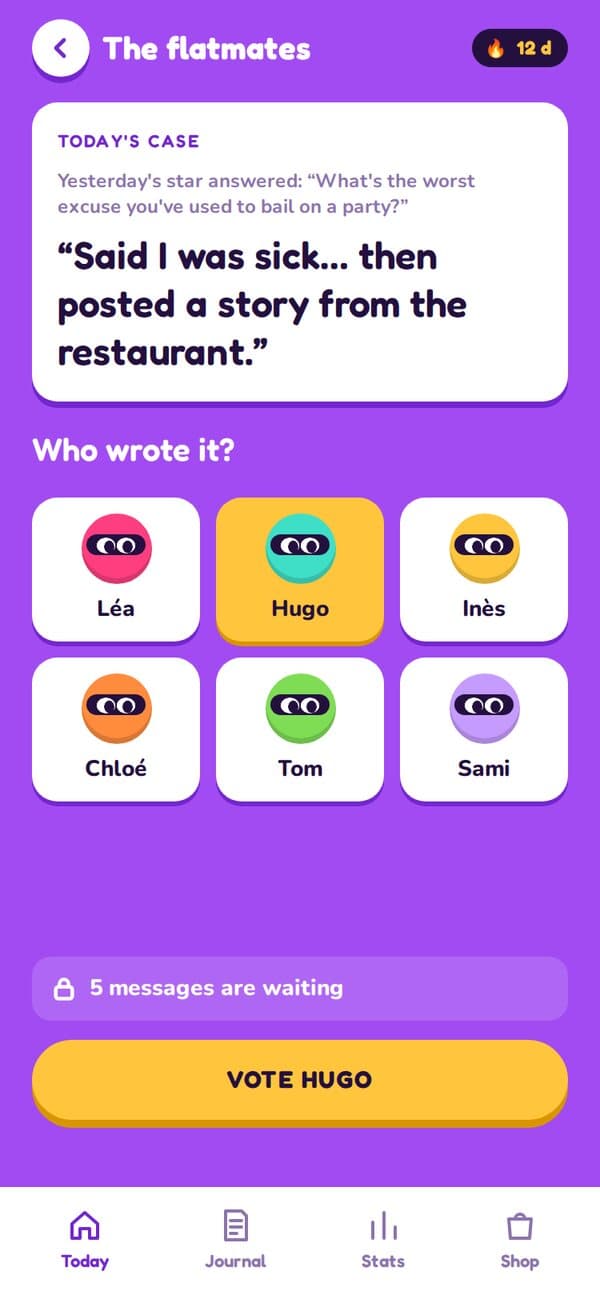
The idea: one person secretly answers a question ("What's the worst excuse you've used to bail on a party?"), then the group reads the answer without knowing who wrote it and votes for the author. The fun is as much in the vote as in the argument that follows: "it's obviously Léa, she always does that".
Remotely, you need someone to collect answers in private messages and repost them anonymously. That's exactly what Who Was It does, automatically: every day one member of the group is drawn and answers in secret, and the next day everyone investigates and votes.
- Players: 3 or more.
- Time: 2 minutes a day.
- Best for: groups that never manage to schedule a call.
2. Two truths and a lie
Taking turns, each person posts three statements about themselves: two true, one false. The others vote for the lie, by replying or with a chat poll. The game works best when the truths are surprising and the lie is believable.
- Players: 3 to 15.
- Time: a few minutes per turn, over a day.
- Tip: one turn a day gives everyone time to answer.
3. Voice-note music quiz
One person prepares ten song snippets, hummed or recorded from a speaker, and sends them one by one as voice notes. The first to give the title and artist scores a point. Suggested theme: the hits of your school years.
- Players: 3 or more.
- Time: 20 minutes live, or one song a day.
- Tip: off-key humming makes the game funnier, not harder.
4. Online drawing games
Browser drawing games, Pictionary-style or drawn telephone, play on a video call with nothing to install: one player creates a game, shares the link, and everyone draws in turn while the others guess. The results are rarely pretty and always funny.
- Players: 4 to 12.
- Time: 30 minutes to an hour, live.
- You need: a computer or tablet each, which is more comfortable than a phone.
5. Photo of the day
Every morning someone sets a theme ("the view from your window", "your lunch", "the most useless object in your home") and everyone posts a photo before midnight. No winner, just a glimpse of everyone's life, which often gets the conversation going again.
- Players: no limit.
- Time: 30 seconds a day.
- Tip: take turns choosing the theme, one person per day.
6. Prediction league
A match, a TV show final, Eurovision, the weekend weather: everyone makes a prediction before the event, and a shared spreadsheet keeps score over the season. It's a great excuse to talk while the event is on.
- Players: 3 or more.
- Time: one minute per event.
- Tip: a small stake (last place buys the drinks next time) keeps everyone motivated.
7. The group trivia quiz
One person writes ten questions about the group itself: "What year was that legendary weekend by the sea?", "Who lost their keys three times in one night?". Play it on a call, or one question a day in the chat. It's the best way to dig up old memories.
- Players: 4 or more.
- Time: 20 minutes live.
- Tip: ask for a throwback photo with every right answer.
8. Movie of the week club
The group votes for a film or an episode, everyone watches it during the week whenever they like, and you talk about it on Sunday night, in the chat or on a call. Game version: everyone gives a score out of 10 before the discussion, then you compare.
- Players: no limit.
- Time: one film, whenever you want.
- Tip: take turns picking, to get out of one person's taste.
How to choose
It all depends on how available the group is:
- You can schedule a call: drawing games, the music quiz or the group trivia quiz make a great night in, remotely.
- You never share the same free slot: pick an asynchronous game everyone plays whenever they like, such as Who wrote it?, photo of the day or predictions.
- The group is big (more than ten): games where everyone answers at once, like predictions or photo of the day, avoid waiting for your turn.
- You live in different time zones: a daily game with a fixed time gives everyone the whole day to take part.
Our tips to make it last
Keeping in touch isn't just a matter of goodwill. Studying the social networks of 251 women, Sam Roberts and Robin Dunbar showed that communication keeps relationships from decaying over time, and that a friendship costs more effort to maintain than a family tie. Jeffrey Hall, across two studies (355 adults who had just moved, then 112 first-year students followed over nine weeks), found that hours spent together, shared leisure activities and everyday talk bring friends closer. A regular game ticks all three boxes, even long-distance.
- A fixed time: a game "every day at 10" or "every Sunday" settles in much better than a game started at random.
- Short first: a game that takes two minutes a day survives, a game that takes an hour runs out of steam.
- Nobody has to: whoever skips this week will come back next week if nobody holds it against them.
- Light scores: the leaderboard is an excuse, not the point. What matters is the conversation around it.
The real test: if the game makes the group chat laugh at least once a week, it's a keeper.